
Resignation Letter Template
A resignation letter is short, but it matters: it confirms your decision, sets your last day and leaves a good final impression. Enter your name, manager, role and notice period, choose the tone, and the template writes a clear, polite letter with your last working day worked out for you. Edit anything you like, then copy it into an email, print it or download it for Word.
- Free to use
- No sign-up
- Runs in your browser
Resignation letter builder
You can edit the letter directly in the box before copying or downloading.
Career Transition Kit
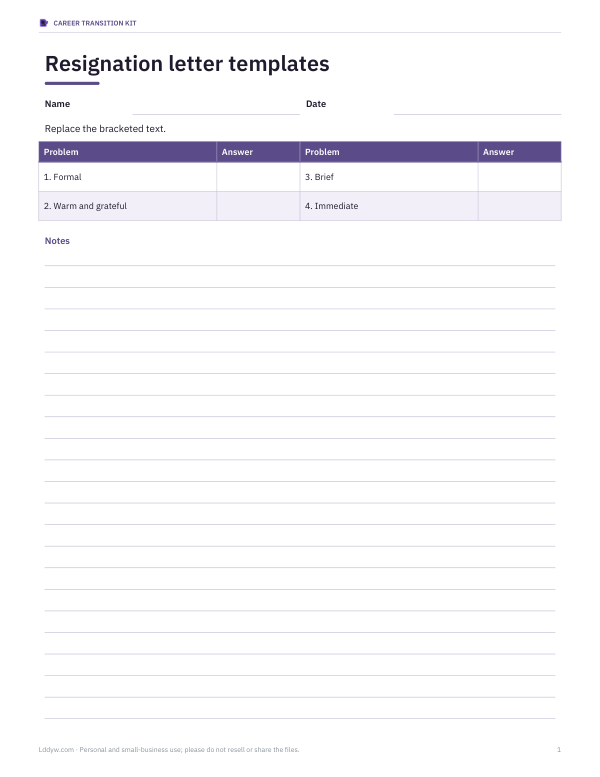
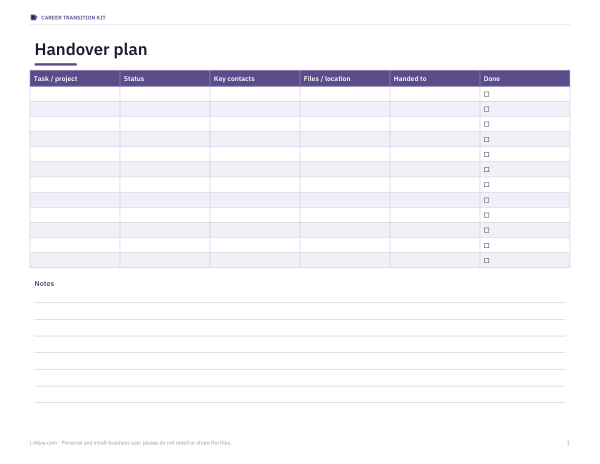
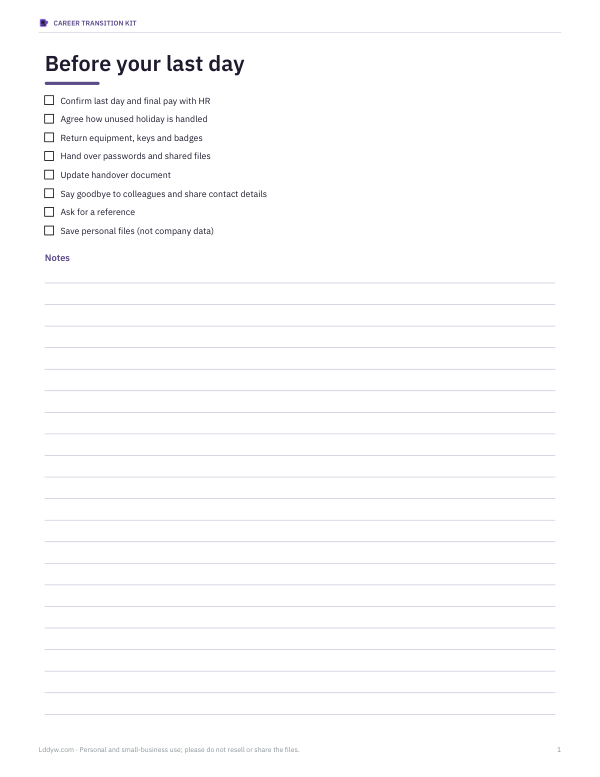
Printable career transition kit: resignation letter templates in four styles (Word), a handover plan, a last-weeks checklist, a reference request letter and a new job first-week planner.
- Letter templates (DOCX/PDF)
- Handover plan (DOCX/PDF)
- Last weeks checklist (PDF, DOCX)
- Reference request (DOCX)
Formats: PDF, DOCX. Instant download after payment (link valid 72 hours, up to 5 downloads). AI-assisted: the templates were drafted with AI help and reviewed and laid out before publishing.
$5.00 USD, one-time 4 files · about $1.25 each
- Instant download
- 7-day refund
- Secure checkout by Stripe
7-day money-back guarantee. Full refund within 7 days of purchase, even after you download.
Free sample: Handover Plan (PDF, 83 KB)
Full refund within 7 days — see the refund policy and license.
Free printables
Single sheets you can print right now, no sign-up. The full pack adds every sheet in one download plus the editable files.
 Reference Request Letter Template
What to include in a resignation letter
| Part | What to write |
|---|---|
| Date and addressee | The date you hand it in and your manager’s name |
| Clear statement | That you are resigning from your specific position |
| Last working day | Worked out from your contractual notice period |
| Thanks | A short, sincere thank-you — keep it positive |
| Handover | An offer to help with the transition (optional but appreciated) |
| Sign-off | “Yours sincerely” and your name; sign it if printing |
You don’t have to give a reason. If you do, keep it brief and positive — the letter goes into your employment file.
Working out your notice period
Your employment contract or handbook usually sets how much notice you must give; if it doesn’t, local law may set a minimum. Notice normally starts the day after you hand in your resignation. In the United States, two weeks is a common courtesy for at-will employees, while in the UK and many other countries statutory and contractual notice periods apply and are often one month or more for salaried roles. The builder adds your notice period to the letter date — check your contract and confirm the final date with HR.
How to use the builder
- Enter your name, job title, company and manager.
- Set the date you will hand the letter in and choose your notice period.
- Pick a style: formal, warm and grateful, brief, or immediate resignation.
- Choose whether to give a reason and whether to offer help with the handover.
- Read the letter, edit anything directly in the box, then copy, download for Word or print.
Everything happens in your browser; nothing you type is sent or stored.
Worked example
Jordan hands in a formal letter on 2 October with a two-week notice period. The builder sets the last working day to 16 October, a Friday, and writes a short formal letter to Sam that states the resignation, the last day, an offer to document work and train a replacement, and thanks for the development opportunities. Jordan edits one sentence to mention a specific project, downloads the Word file, signs a printed copy and also emails it so there is a dated record.
Choosing the tone
| Style | When to use it |
|---|---|
| Formal | Most workplaces; a safe default |
| Warm and grateful | You have a good relationship with your manager |
| Brief | You have already discussed it in person |
| Immediate | Exceptional circumstances; check your contract first, as leaving without notice can have consequences |
Before and after you hand it in
- Tell your manager in person or by video call first, then give the letter.
- Check your contract for notice, holiday pay, bonuses and restrictive clauses.
- Find out how unused holiday will be handled.
- Ask for a reference while relationships are good.
- Plan your handover: list tasks, contacts, passwords to reset and files to share.
- Stay professional to the last day — people remember how you leave.
Handing in your resignation
- Ask your manager for a short private meeting.
- Tell them your decision clearly and calmly, and say when your last day will be.
- Hand over the printed letter or send the email straight after the meeting.
- Agree how and when the team will be told.
- Follow up with HR about final pay, holiday and the leaving process.
If your manager makes a counter-offer, it is fine to ask for time to think — but decide before you resign whether anything would change your mind.
Leaving on good terms
Former managers and colleagues often become references, clients or future colleagues. Finish your work well, write a clear handover, thank the people who helped you and stay positive in exit interviews — give honest feedback, but keep it constructive and specific.
Email or printed letter?
Many employers accept resignation by email, and an email gives you a dated record. Some contracts require notice “in writing”, which email usually satisfies, but check the wording. A signed printed letter handed to your manager is still common for formal workplaces. Doing both — hand over a signed letter and send the same text by email — covers every case.
Common mistakes
- Criticising the company, manager or colleagues in writing.
- Getting the last day wrong or forgetting the notice period.
- Leaving the date off the letter.
- Resigning by text or social media.
- Announcing the move publicly before telling your manager.
Legal note
Employment rules differ between countries, states and contracts. This builder produces a general letter; for questions about notice, pay or restrictive covenants, check your contract and seek advice from HR, a union or an employment adviser.
Frequently asked questions
How do I write a resignation letter?
State your resignation, your position, your last working day, a thank-you and your signature.
How much notice should I give?
Whatever your contract says; two weeks is common in the US, often a month or more elsewhere.
Do I need to give a reason for resigning?
No, it is optional; keep any reason brief and positive.
Can I resign by email?
Often yes, but tell your manager in person first and check your contract.
Can I edit the letter?
Yes, edit directly in the letter box.
Is my information saved?
No, nothing is stored or sent.
What if my last day falls on a weekend?
Check with HR; many employers use the last working day before it.
Should I mention my new employer?
It is not necessary; many people simply say they have accepted a new opportunity.